
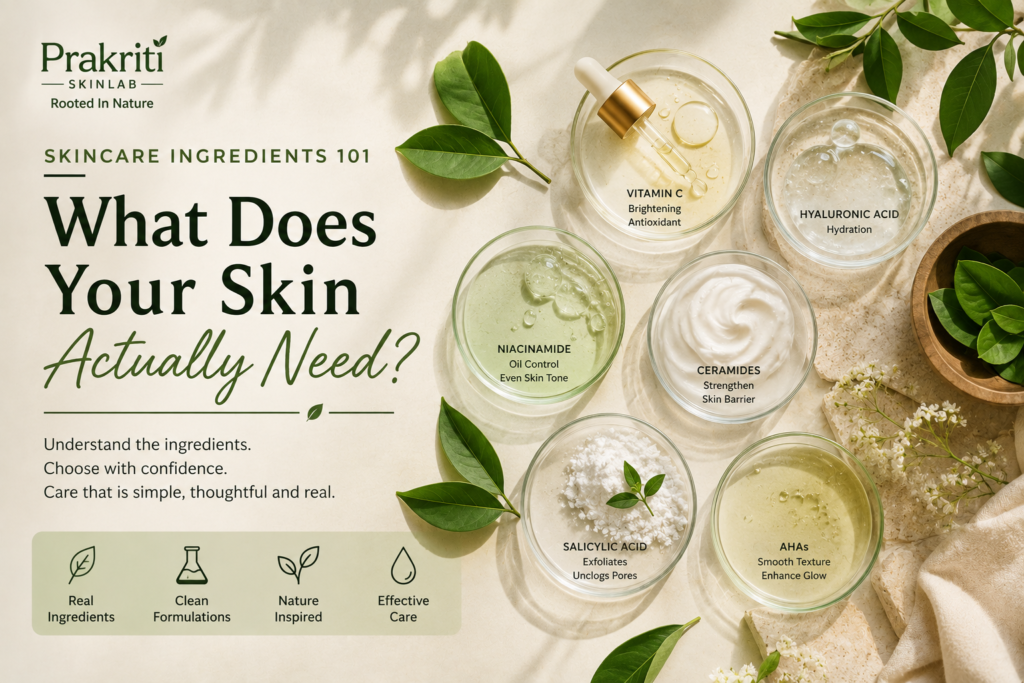
Walk into any skincare store and you’ll find words like niacinamide, vitamin C, hyaluronic acid, ceramides, salicylic acid, and AHAs everywhere.
They sound impressive—but what do they actually do?
With so many ingredients trending on Instagram, YouTube, and beauty websites, choosing skincare can quickly become confusing. You may even find yourself buying a product because an ingredient is popular without knowing whether your skin actually needs it.
The truth is simple: there is no single “best” skincare ingredient for everyone.
The right ingredient depends on your skin type, your concerns, the formulation, and how your skin responds to it.
At Prakriti Skinlab, we believe understanding your ingredients is just as important as choosing your products. So let’s make skincare ingredients easier to understand.
What Are Skincare Ingredients?
Skincare ingredients are the individual substances used in a product to create its texture, maintain the formula, or provide a particular cosmetic benefit.
Some ingredients help hydrate the skin. Others help exfoliate, support the skin barrier, provide antioxidant protection, or improve the appearance of uneven-looking skin.
But one important thing to remember is that an ingredient does not work in isolation.
The concentration, formulation, combination of ingredients, frequency of use, and your individual skin can all influence how a product feels and performs.
That’s why simply seeing a “powerful” ingredient on a label isn’t enough.
1. Niacinamide: The Everyday Multitasker
Niacinamide is a form of vitamin B3 and has become one of the most popular skincare ingredients.
Why?
Because it can fit into many different routines.
It is commonly used in products designed to support the skin barrier, improve the appearance of uneven skin tone, and help manage the look of excess oil.
That makes it particularly popular among people with oily or combination skin, although its usefulness isn’t limited to those skin types.
Think of niacinamide as: an adaptable everyday ingredient.
It is often found in serums, moisturizers, cleansers, and other skincare products.
2. Hyaluronic Acid: For Hydration
Despite its complicated-sounding name, hyaluronic acid is primarily associated with hydration.
It is a humectant, meaning it helps attract and hold water.
When your skin feels dehydrated or tight, hydration-focused ingredients can be useful in a routine.
But there is a common misunderstanding: hyaluronic acid does not mean “instant glass skin.”
Your overall routine still matters.
A hydrating ingredient works as part of a broader approach that may include a suitable cleanser, moisturizer, and protection from environmental exposure.
Think of hyaluronic acid as: a hydration-focused ingredient.
3. Vitamin C: Antioxidant Support
Vitamin C is well known in skincare for its antioxidant properties.
Antioxidants help protect against oxidative stress caused by free radicals. Vitamin C is also commonly used in skincare designed to improve the appearance of dullness and uneven-looking skin tone.
However, not every vitamin C product is the same.
Different forms of vitamin C can have different stability and formulation requirements.
This is one reason skincare shouldn’t be judged simply by whether the ingredient name appears on the front of the packaging.
Think of vitamin C as: an antioxidant and brightening-focused ingredient.
4. Ceramides: Supporting Your Skin Barrier
Your skin has a natural barrier that helps keep moisture in while protecting it from external stressors.
Ceramides are lipids naturally found in the skin and are widely used in skincare products designed to support that barrier.
They are especially popular in moisturizers and barrier-focused formulations.
If your routine contains too many irritating products, your skin may start feeling uncomfortable, tight, or unusually dry. A simpler, barrier-supportive routine may then make more sense.
Think of ceramides as: barrier-supporting ingredients.
5. Salicylic Acid: Exfoliation for Congested Skin
Salicylic acid is a beta hydroxy acid, commonly known as BHA.
It is widely used in products designed for oily or acne-prone skin because of its exfoliating properties and ability to work within oily environments.
It can be useful when you’re dealing with concerns such as clogged-looking pores and excess oil.
But stronger does not automatically mean better.
Using exfoliating ingredients too frequently can leave some people’s skin feeling dry or irritated.
Think of salicylic acid as: an exfoliating ingredient often used for oily and congested-looking skin.
6. AHAs: Surface-Level Exfoliation
Alpha hydroxy acids, or AHAs, are another family of exfoliating ingredients.
Examples include glycolic acid and lactic acid.
They are commonly used to exfoliate the skin’s surface and improve the appearance of dullness and uneven texture.
But exfoliation should be intentional.
You don’t need multiple exfoliating products simply because they contain different acids.
Sometimes the simplest routine is the most sustainable one.
Think of AHAs as: surface exfoliators for smoother-looking skin.
How Do You Choose the Right Ingredient?
This is where most people make a mistake.
They begin with the ingredient rather than the concern.
Instead, start with this question:
“What am I actually trying to improve?”
If your main concern is:
Dryness or dehydration: Look for hydration-focused ingredients such as hyaluronic acid alongside a suitable moisturizer.
Excess oil: Ingredients such as niacinamide may fit well into an oil-focused routine.
Uneven-looking skin tone: Vitamin C and other brightening-focused ingredients may be considered.
A compromised-feeling skin barrier: Ceramide-containing, barrier-supportive formulations may be useful.
Clogged pores or excess oil: Salicylic acid may be an option.
Dullness or uneven texture: AHAs can be considered when appropriate.
But these are general categories—not universal rules.
Your skin may respond differently from someone else’s.
Can You Use Multiple Ingredients Together?
Yes, some ingredients can be combined.
But more combinations do not automatically mean better results.
For someone new to skincare, introducing several active ingredients simultaneously can make it difficult to know which product is helping—or causing irritation.
A better approach is to introduce products gradually.
Pay attention to how your skin feels.
And don’t change five things at once.
Your skincare routine is not a chemistry experiment.
You don’t need to use every trending ingredient simply because it’s popular.
What About “Natural” Ingredients?
This is especially important.
The word natural does not automatically mean safe for everyone.
Plants, essential oils, and botanical extracts can be beneficial components of skincare, but they can also cause irritation or sensitivity in some people.
At the same time, a lab-created ingredient isn’t automatically bad.
What matters is the ingredient, the formulation, concentration, quality, and how your skin responds to it.
Good skincare is about thoughtful formulation—not simply choosing between “natural” and “chemical.”
Read the Product, Not Just the Marketing
Marketing language can make any ingredient sound extraordinary.
Words like:
Glow
Detox
Clean
Miracle
Powerful
Instant
can attract attention, but they don’t tell you everything about a formulation.
Instead, ask:
What is this product designed to do?
Which ingredients support that goal?
Is it suitable for how my skin behaves?
Can I realistically use it consistently?
Those questions are much more useful than simply following a trend.
The Best Skincare Ingredient Is the One That Fits Your Routine
There is no universal winner.
Your friend may love vitamin C.
Someone else may prefer niacinamide.
Another person may need nothing more complicated than a gentle cleanser, moisturizer, and sunscreen.
Your skin has its own needs.
And those needs can change over time.
The goal isn’t to collect ingredients.
The goal is to understand them.
At Prakriti Skinlab, we believe skincare should be simple enough to understand and thoughtful enough to trust.
Real Ingredients. Real Care. Real You.
Because skincare isn’t about chasing every new ingredient.
It’s about finding what makes sense for your skin—and staying consistent. 🌿
Prakriti Skinlab — Rooted in Nature.